

Stoke-on-Trent’s industrial character is one of the most distinctive in England. The pottery and ceramics heritage that gave the city its identity – and the collective name the Potteries – has been joined over the decades by a broader manufacturing and engineering base that today includes advanced materials, automotive components, logistics, and a range of precision industrial processes. What those sectors share is a common operational requirement: the controlled movement of loads that manual handling cannot safely or consistently deliver.
Jib cranes are among the most versatile fixed-point lifting solutions available to industrial businesses, and their suitability for the kind of manufacturing environments found across Stoke and the wider Staffordshire area is well established. Whether the application is a ceramics production facility handling kiln furniture and fired ware, an automotive supplier loading and unloading press tools, or an engineering business presenting workpieces to a machining centre, a properly specified jib crane delivers the control and repeatability that the process demands.
The Jib Crane’s Role in Production
The most important thing to understand about a jib crane is where it fits in the material flow. Unlike an overhead travelling crane, which is designed to move loads across large areas of a facility, a jib crane is a workstation tool. It serves a single point — a machine, an assembly station, a loading bay, a process cell — and it serves it with speed and precision that general-purpose lifting equipment cannot match.
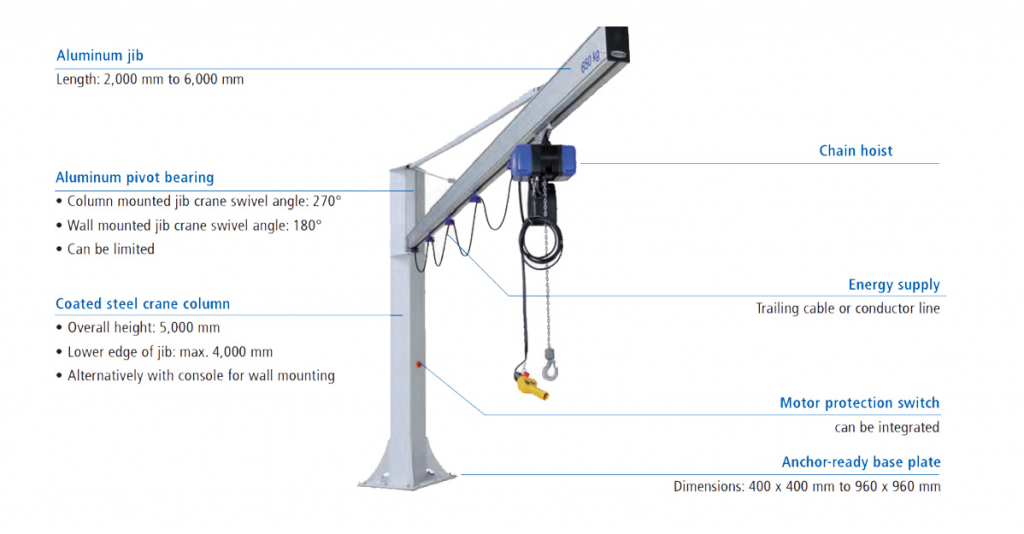
Column-mounted jib cranes stand independently from building steelwork, fixed to the floor on a structural base. They offer a 270-degree pivot arc that covers a wide working radius from a single installation, and they require no modification to the building envelope. Wall-mounted options attach to suitable structural steelwork where available, saving floor space in tighter layouts.
The Schmalz jib crane supplied by Turbo Vacuumentation Ltd handles loads up to 1,000 kg on aluminium crane rails, with steel rail configurations available for heavier applications. The transport trolley runs on high-performance plastic rollers in an anodised aluminium section, providing smooth, low-friction movement that supports accurate load positioning. Adjustable variable end stops allow the travel path to be set precisely within the working radius, which is particularly useful when the crane is operating close to fixed machinery or structural elements.
Stoke’s Ceramics and Manufacturing Sectors
The ceramics and advanced materials businesses operating across Stoke-on-Trent and North Staffordshire work with materials that combine significant weight with fragility. Kiln furniture, fired ceramics, greenware in production, and finished ware for export all need to be moved in ways that protect the product and protect the operator. Manual handling of heavy ceramic pieces carries a high risk of both product damage and operator injury. A jib crane with a suitable lifting attachment provides controlled, smooth movement that manual handling simply cannot replicate.
For Stoke’s automotive component suppliers, the loading and unloading of press tools and dies represents one of the most common heavy handling challenges in the sector. Press tools are dense, heavy, and often oddly shaped, making them unsuitable for manual handling above relatively modest weights. A jib crane at the press loading point allows tools to be changed safely and efficiently, reducing downtime and eliminating the injury risk associated with manual tool changes.
The Trentham Lakes and Britannia Way areas host a range of industrial and engineering businesses with similar handling requirements. In each case, the specific geometry of the application differs, but the fundamental need is the same: a reliable, controlled lifting device at the point where it is needed.
Installation and the Regulatory Framework
The Manual Handling Operations Regulations require employers to avoid manual handling that carries a risk of injury wherever it is reasonably practicable to do so. For loads above approximately 25 kg, and particularly for loads that are also awkward, fragile, or handled frequently, the practicability of mechanical alternatives is straightforward to demonstrate.
A jib crane installation is not a large infrastructure project. Column-mounted cranes are installed without structural modifications to the building. The installation process is managed by Turbo Vacuumentation’s engineering team from specification through to commissioning, and the equipment is ready for operational use from the point of handover.
The maintenance-free pivot bearing and wear-resistant crane rail components mean that once installed, the jib crane requires minimal ongoing attention. Service life is long, and the investment cost is modest relative to the value of the handling improvement delivered.
About Turbo Vacuumentation Ltd
Turbo Vacuumentation Ltd is an independent, privately owned business based in Stockport, and has been a trusted UK distributor of J. Schmalz GmbH since 1996. The company provides a total solution to practically any vacuum handling application, with its technical team on hand to advise on the specifications, capacity, and performance that best suit each customer’s individual needs. Solutions are drawn from the extensive Schmalz range or developed as bespoke equipment by Turbo Vacuumentation’s own design team. All of this is backed by the unrivalled technical support and aftersales service that has made the business a trusted name in UK industry for nearly thirty years.
For manufacturers and engineers in Stoke-on-Trent and across Staffordshire, Turbo Vacuumentation has the expertise and the product range to deliver the right lifting solution.
Contact Turbo Vacuumentation Ltd at turbo-vac.co.uk or call 0161 482 4004 to discuss jib crane requirements for your Stoke-on-Trent or Staffordshire facility. View the full jib crane range.