

Preston has long punched above its weight as an industrial powerhouse. Its proximity to major transport routes – the M6, M55, and the West Coast Mainline – makes it a natural hub for manufacturing, engineering, and distribution. Companies across Ribbleton, Bamber Bridge, and Leyland’s surrounding business parks operate in competitive, fast-moving sectors where downtime is costly and workplace injuries even more so. For those businesses, smarter materials handling isn’t a luxury – it’s a strategic necessity. And jib cranes are fast becoming the solution of choice.
Lifting the Lid on Jib Crane Technology
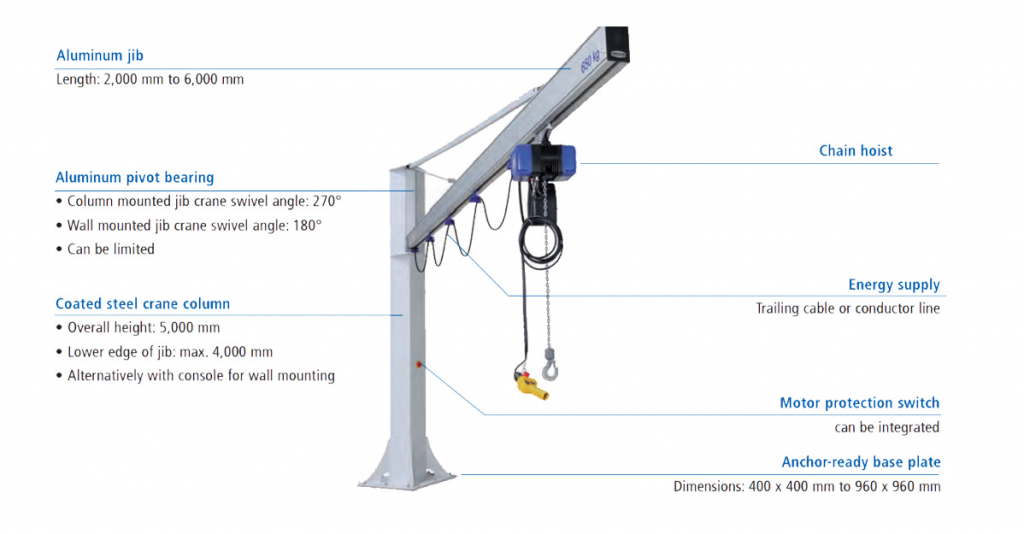
If you haven’t looked closely at jib cranes recently, it’s worth understanding what modern systems can actually do. At their core, a jib crane consists of a pivoting horizontal boom – mounted either to a wall bracket or a floor-standing column – from which a hoist or lifting device is suspended. The boom rotates through a wide working arc, giving operators the ability to position loads precisely across a defined area without moving their feet.
What makes this so valuable on a working production floor is the combination of reach and control. Unlike fixed conveyors or manual trolleys, a jib crane brings the load to the worker, reducing unnecessary movement, improving positioning accuracy, and keeping the pace of work consistent throughout a shift.
Protecting Your People and Your Productivity
Ask any health and safety manager in a Preston factory or warehouse about their biggest daily concern, and manual handling will almost certainly come up. Back injuries, shoulder strains, and repetitive stress conditions are persistently common across UK industry – and they carry a significant cost, both in human terms and in lost working days, insurance claims, and HSE compliance risk.
Jib cranes fundamentally change the equation. By transferring lifting and repositioning tasks to a mechanical system, they remove the strain from the operator and replace unpredictable physical effort with smooth, controlled movement. Workers can handle heavier loads more frequently, with less fatigue and a far lower risk of injury. Over time, that shift pays dividends across sickness absence rates, staff retention, and overall morale.
Productivity gains follow naturally. When workers aren’t slowed down by physical exertion or waiting for additional colleagues to assist with heavy lifts, throughput improves. A jib crane positioned at a key workstation can quietly transform the pace and consistency of an entire production cell.
Why Schmalz Systems Set the Standard
When it comes to specifying a jib crane, the quality of engineering matters enormously – particularly in high-cycle industrial environments where reliability is non-negotiable. Schmalz has built a strong reputation in this space, and their jib crane systems reflect a level of precision design that makes a real difference in day-to-day operation.
One of the most practical decisions in the Schmalz range is the choice between column-mounted and wall-mounted configurations. In Preston’s older industrial buildings – many of which feature substantial existing steelwork – a wall-mounted Schmalz crane can be fixed directly to the structure, keeping the floor clear and minimising installation costs. For newer builds or open-plan facilities without suitable structural anchors, freestanding column-mounted units provide the same operational capability without any dependency on the building’s frame.
Load capacity is handled intelligently too. Schmalz cranes handling up to 1,000 kg use aluminium crane rails, which keep the moving mass low and deliver impressive responsiveness – operators can position loads quickly and precisely with minimal physical effort. Step above 1,000 kg and the system transitions to steel crane rails, maintaining the same operational standards at greater capacity.
The component engineering is equally considered. A maintenance-free spherical pivot bearing makes swivelling smooth and effortless even at the point closest to the column, while purpose-built aluminium transport trolleys with high-performance plastic rollers ensure consistent, low-friction travel along the boom. Power supply is handled cleanly via an integrated cable trolley system that accommodates both electrical cables and pneumatic hoses, keeping trailing lines tidy and hazard-free. For installations where even cable management is a concern, a conductor line option delivers wireless power via insulated plastic rails – removing cable loops from the equation entirely.
The overall effect is a crane that feels responsive and light to operate, regardless of the load it’s carrying – a detail that matters enormously when operators are using the system dozens of times per shift.
Turbo Vacuumentation Ltd: Preston’s Route to Schmalz Expertise
Choosing the right jib crane for your site involves more than picking a spec sheet – it requires understanding your space, your loads, your workflow, and your long-term operational needs. That’s where Turbo Vacuumentation Ltd comes in. As a trusted UK distributor of Schmalz crane systems, they bring the product knowledge and practical expertise to help Preston businesses specify, supply, and implement the right solution first time. Whether you need a single jib crane for a specific workstation or a broader gantry crane solution across a larger facility, their team is well placed to help.
To find out more about Schmalz jib crane systems and how Turbo Vacuumentation Ltd can support your Preston operation, visit: https://www.turbo-vac.co.uk/crane-systems/jib-cranes/