

Warrington occupies a uniquely powerful position in the North West’s industrial landscape. Sitting at the crossroads of the M6 and M62, with easy access to the Port of Liverpool and Manchester’s distribution networks, it has attracted a remarkably diverse mix of industry – from chemical processing and advanced manufacturing to logistics, food production, and specialist engineering. Businesses in Birchwood, Winwick Quay, and Gemini Business Park know better than most that operational efficiency isn’t just about having the right workforce – it’s about giving that workforce the right tools. Increasingly, those tools include jib cranes.
A Smarter Approach to Materials Handling
Many Warrington facilities are still managing heavy lifting through a combination of manual effort and aging equipment that was never designed for today’s production volumes or safety standards. The result is a hidden drag on output – slower cycle times, higher injury rates, and mounting pressure on supervisors to manage risk manually rather than engineering it out.
Jib cranes offer a fundamentally different approach. Rather than moving workers to loads, they bring loads to workers. A pivoting boom – fixed either to a structural wall or a freestanding column – carries a hoist or lifting attachment that can sweep through a wide operational arc, covering an entire workstation or machine cell with precision and speed. There’s no need for large gantry infrastructure, no requirement for fork lift intervention on every pick, and no bottleneck when a heavy component needs repositioning mid-task.
For Warrington’s high-throughput sectors in particular – warehousing, automotive supply chains, chemical handling – that kind of responsive, localised lifting capability can make a measurable difference to daily output figures.
The Hidden Cost of Getting Lifting Wrong
Warrington businesses operating under lean or just-in-time principles understand that inefficiency compounds. A manual lift that takes three minutes instead of thirty seconds, repeated across a ten-hour shift, doesn’t just slow a line – it exhausts the people running it. And exhausted workers make mistakes.
The Health and Safety Executive consistently identifies manual handling as a primary driver of workplace musculoskeletal disorders, which account for a significant proportion of all work-related illness across UK industry. Beyond the human cost, the business implications are serious: increased absenteeism, employer liability exposure, potential HSE enforcement action, and the less visible but very real cost of reduced output from workers managing discomfort or pain.
Mechanising the lift removes this risk at source. Jib cranes allow a single operator to handle loads safely and repeatedly throughout a shift, without building fatigue, without needing a second pair of hands, and without the inconsistency that comes when physical capacity varies across individuals or across the day. The investment tends to pay back quickly – often within months – when measured against reduced injury claims and improved throughput alone.
Schmalz Jib Cranes: Built for Demanding Environments
Warrington’s industrial base spans everything from clean-room manufacturing to heavy fabrication, and a jib crane solution needs to be genuinely adaptable to perform across that range. Schmalz cranes are designed with exactly this kind of operational diversity in mind.
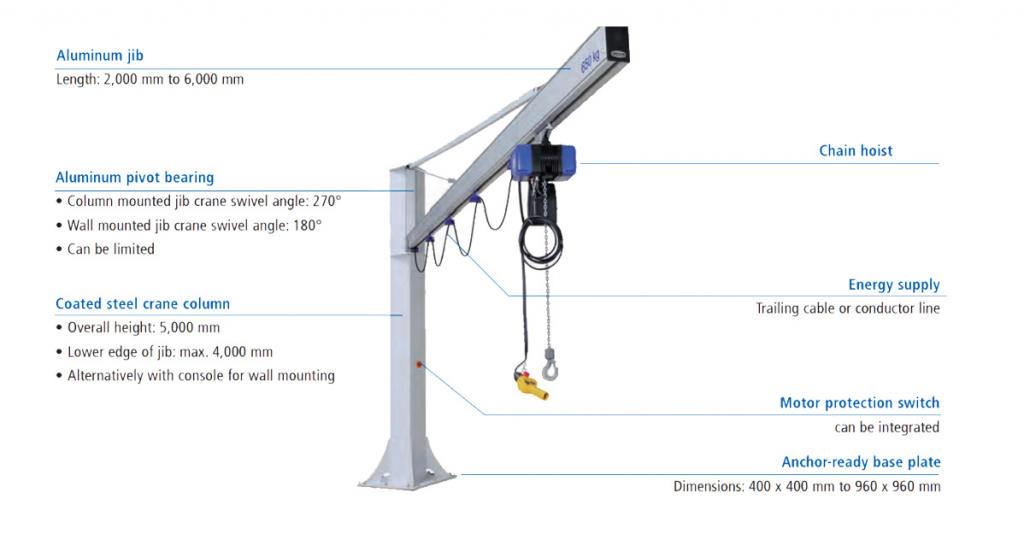
The choice of mounting configuration is a practical starting point. Wall-mounted Schmalz cranes can be secured directly to existing building steelwork – a sensible option in many of Warrington’s established industrial units where the structural frame is both solid and accessible. This approach saves floor space and keeps installation straightforward. Where the building doesn’t lend itself to wall mounting, column-mounted units stand independently and can be positioned precisely where the workflow demands, without any structural compromise.
Schmalz’s approach to load capacity reflects similar engineering intelligence. Systems handling loads up to 1,000 kg are equipped with aluminium crane rails – a deliberate choice that minimises moving mass and maximises the responsiveness operators feel when manoeuvring a load. For heavier industrial applications above 1,000 kg, steel crane rails take over, delivering the structural robustness required without any sacrifice in operational control.
The finer details are where Schmalz really earns its reputation. The pivot bearing is designed for effortless, maintenance-free swivelling across the full range of movement, including at the tightest point near the column. Transport trolleys – precision-cast in aluminium with oversized plastic rollers – run with minimal friction along the boom, giving operators fine positional control even with significant loads suspended. Cable management is integrated from the outset: a trailing cable system routes both power and pneumatic supply cleanly along the crane arm, while an optional conductor line using insulated plastic rails eliminates loose cables altogether for installations where a completely unobstructed working environment matters.
The result is a system that handles demanding duty cycles without fuss – reliable, low-maintenance, and genuinely pleasant to operate day in, day out.
Turbo Vacuumentation Ltd: The Right Partner for Warrington Businesses
Specifying and sourcing the right crane system is easier when you’re working with people who know the product inside out. Turbo Vacuumentation Ltd is a trusted UK distributor of Schmalz jib crane systems, with the expertise to support Warrington businesses from initial enquiry through to a fully operational solution. Whether you’re equipping a single assembly station, fitting out a new facility, or looking for gantry crane provision at scale, their team can match the right Schmalz system to your exact requirements.
Discover the full range of Schmalz jib crane systems and speak to the Turbo Vacuumentation Ltd team about your Warrington operation here: https://www.turbo-vac.co.uk/crane-systems/jib-cranes/