

Cheshire’s industrial identity is often underestimated by those who associate the county primarily with its rural landscape and affluent commuter towns. In reality, Cheshire is home to one of the most significant concentrations of industrial activity in the North West. The chemical and pharmaceutical sector around Ellesmere Port and Runcorn is among the largest in Europe. Advanced manufacturing operations across Crewe, Middlewich, and Winsford supply automotive, aerospace, and food production industries. Logistics hubs along the M6 corridor serve national distribution networks around the clock.
Across all of these sectors, the efficient and safe movement of heavy loads is a daily operational requirement. And for a growing number of Cheshire businesses, jib cranes are the solution of choice.
What Makes Jib Cranes the Right Fit for Cheshire Industry
Cheshire’s industrial diversity means that material handling requirements vary considerably from one business to the next. A chemical processing plant has very different lifting needs from a vehicle parts manufacturer or a food production facility. What jib cranes offer across all of these environments is precisely targeted, workstation-level lifting capability that does not require the infrastructure or expense of a full overhead gantry system.
A jib crane serves a defined working zone. Its rotating boom, extending from either a wall bracket or a freestanding column, covers a working arc of up to 270 degrees over a specific area, allowing an operator to lift, position, and set down loads with precision and repeatability that manual handling simply cannot deliver. For Cheshire businesses where components are heavy, cycle times are tight, or worker safety is under increasing scrutiny, that combination of precision and efficiency is genuinely transformative.
The health and safety dimension is also particularly relevant in Cheshire’s chemical and pharmaceutical sectors, where manual handling risks carry additional complexity due to the nature of the materials involved. Removing the physical demand of heavy lifting from operators in these environments is not just an efficiency measure. It is a meaningful risk reduction that supports compliance with both the Manual Handling Operations Regulations and the broader duty of care obligations that apply in hazardous working environments.
Column Mounted or Wall Mounted: Getting the Configuration Right
One of the most important decisions when specifying a jib crane is choosing between a column-mounted and a wall-mounted installation, and the right answer depends entirely on the characteristics of the building and workflow in question.
Cheshire’s industrial estate stock ranges from purpose-built modern units on parks like Gadbrook Park in Northwich and Crewe Gates to older converted industrial buildings where structural steelwork may already be in place. Where robust existing steelwork can support a wall-mounted system, fixing the crane directly to the structure saves floor space, reduces installation complexity, and avoids the need for an additional foundation or base plate.
Where no suitable wall fixing point exists, a freestanding column-mounted system provides identical operational capability from a self-supporting base. This is the right choice for open-plan facilities, for locations where the optimal working position is away from any external wall, or for businesses that want the flexibility to reposition the crane if their workflow changes over time.
Schmalz Jib Cranes: The Engineering Standard for Demanding Environments
Across Cheshire’s varied industrial sectors, the performance demands placed on lifting equipment are high. A jib crane that works well in the first few months but degrades under repeated heavy use is not a solution. It is a deferred problem.
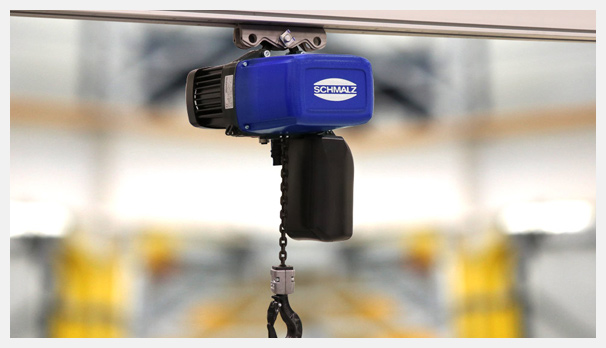
The Schmalz jib crane range, available through Turbo Vacuumentation Ltd, is engineered with longevity and consistent performance as core design principles. For loads up to 1,000 kg, aluminium crane rails keep the system lightweight and highly responsive, so operators can manoeuvre substantial loads with minimal physical effort and position them accurately every time. The maintenance-free spherical pivot bearing delivers effortless swivelling across the full working arc, including at the tightest point nearest the column, without developing stiffness or resistance over time.
Transport trolleys are constructed from pressure-cast aluminium with high-performance plastic rollers that run smoothly along the boom without friction build-up, giving operators fine, consistent positional control. Both electrical supply and pneumatic hose runs are managed cleanly through an integrated trailing cable system that eliminates loose lines from the working area. For installations where a completely unobstructed environment is a priority, an optional conductor line system delivers power via insulated plastic rails with no trailing cables at all.
Turbo Vacuumentation Ltd: Cheshire’s Specialist Jib Crane Supplier
Selecting the right jib crane for a Cheshire operation means understanding the specific load requirements, building configuration, and workflow demands of the individual site. Turbo Vacuumentation Ltd brings the product expertise and practical experience to guide businesses through that process, supplying Schmalz jib crane systems with the technical support to ensure the right outcome from specification through to installation and beyond.
To discuss your requirements and explore the full range, visit: https://www.turbo-vac.co.uk/crane-systems/jib-cranes/olution for each application. Whether you are equipping a single workstation or looking for a chain hoist solution as part of a broader crane and gantry system, their team brings the product knowledge and practical experience to ensure the right outcome from day one.
To explore the full range and discuss your requirements, visit: https://www.turbo-vac.co.uk/crane-systems/chain-hoists/