

Stockport sits at a fascinating industrial crossroads. On one side, it benefits from its proximity to Manchester’s vast commercial network and the M60 motorway corridor, which gives local businesses fast access to suppliers, customers, and distribution routes across the North West. On the other, it retains a strong identity as a manufacturing and engineering town in its own right, with a history of precision industry that stretches back generations and a current business base that spans aerospace supply chains, specialist engineering, plastics, print, and logistics.
For businesses operating in this kind of environment, material handling efficiency isn’t an abstract concern. It’s a daily operational challenge. Moving heavy components, positioning loads accurately within tight production spaces, and doing all of it without putting workers at risk requires the right equipment. Increasingly, that equipment is a chain hoist.
Rethinking the Lift
There’s a tendency in many manufacturing and engineering businesses to view lifting equipment as an infrastructure decision, something that gets resolved when a facility is first set up and then doesn’t get revisited for years. The problem with that approach is that it locks businesses into solutions that were designed for a previous era of output requirements, safety standards, and operational tempo.
Modern chain hoists are a significant step forward from the equipment many Stockport facilities are currently running. Today’s systems offer far greater precision, meaningfully lower noise levels, and safety features that weren’t standard just a decade ago. They’re also faster and easier to install than their predecessors, which means the barrier to upgrading is lower than many operations managers assume.
The question isn’t really whether a chain hoist would improve your operation. For any business regularly lifting loads of more than a few hundred kilograms, the answer to that is almost certainly yes. The question is which system is the right fit for your specific application.
Safety, Compliance, and the Cost of Getting It Wrong
Stockport businesses, like all UK employers, operate under a framework of health and safety legislation that places clear obligations on how manual handling is managed. The Manual Handling Operations Regulations require employers to assess and reduce manual handling risks where reasonably practicable, and mechanical lifting is widely recognised as one of the most effective ways to do so.
The cost of non-compliance, or of simply failing to act on a known risk, can be substantial. HSE enforcement action, employer liability claims, increased insurance premiums, and the reputational damage of a serious workplace injury all represent real financial exposure. But even setting the regulatory dimension aside, the operational cost of manual handling injuries, lost working days, temporary staffing, and reduced productivity during recovery periods, is enough on its own to make the case for a mechanical solution.
A quality chain hoist doesn’t just protect workers. It protects the business.
What Makes the Schmalz SCH the Right Choice
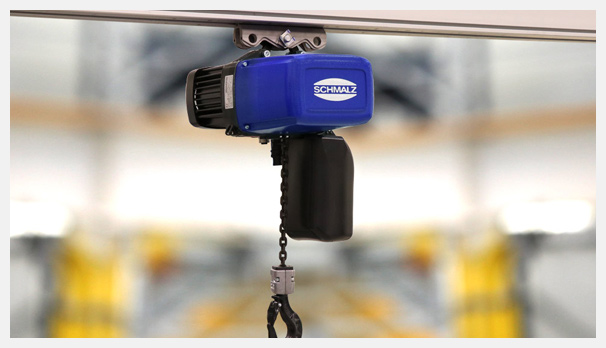
The Schmalz SCH Chain Hoist has been engineered for the demands of serious industrial use, and its specification reflects that clearly.
With a maximum capacity of 2,000 kg and a standard hook path of 3,000mm, it covers the full range of requirements across Stockport’s manufacturing and engineering sectors. The helical gear drive delivers smooth, quiet operation with low vibration, making it comfortable to use across extended duty cycles and well suited to facilities where noise management is a consideration.
Perhaps most significantly for businesses replacing older equipment, the SCH is designed to minimise ongoing maintenance commitment. The gearbox is permanently lubricated, the DC magnetic brake is maintenance-free, and the dual clutch system provides load protection without requiring routine adjustment. Over a multi-year working life, that reduction in servicing overhead represents a meaningful saving compared to less robustly engineered alternatives.
The plug and play electrical connector arrives pre-encoded to prevent incorrect wiring during installation, and the 42V control voltage keeps operator risk to a minimum in challenging industrial environments. For applications demanding precise load placement, the standard gear limit switch provides accurate, repeatable positioning at the end of the hook path, while an optional frequency inverter extends that precision across the full range of movement with infinitely variable speed control.
The cast aluminium housing is robust enough for daily use in demanding environments, and moulded cooling fins manage heat dissipation effectively under sustained high-cycle operation.
Turbo Vacuumentation Ltd: The Right Partner for Stockport Industry
The right chain hoist for any given application depends on specific load requirements, headroom, duty cycle, and the wider crane or gantry system it will operate within. Turbo Vacuumentation Ltd brings the expertise to navigate those variables with Stockport businesses, ensuring the right Schmalz solution is specified, supplied, and supported from day one.
To discuss your requirements and explore the full range, visit: https://www.turbo-vac.co.uk/crane-systems/chain-hoists/